 All Blogs
 "The best way to manage a monthly budget is to stop guessing and start tracking. Prepaid meters turn power into a currency you can see."
What is a Prepaid Meter?
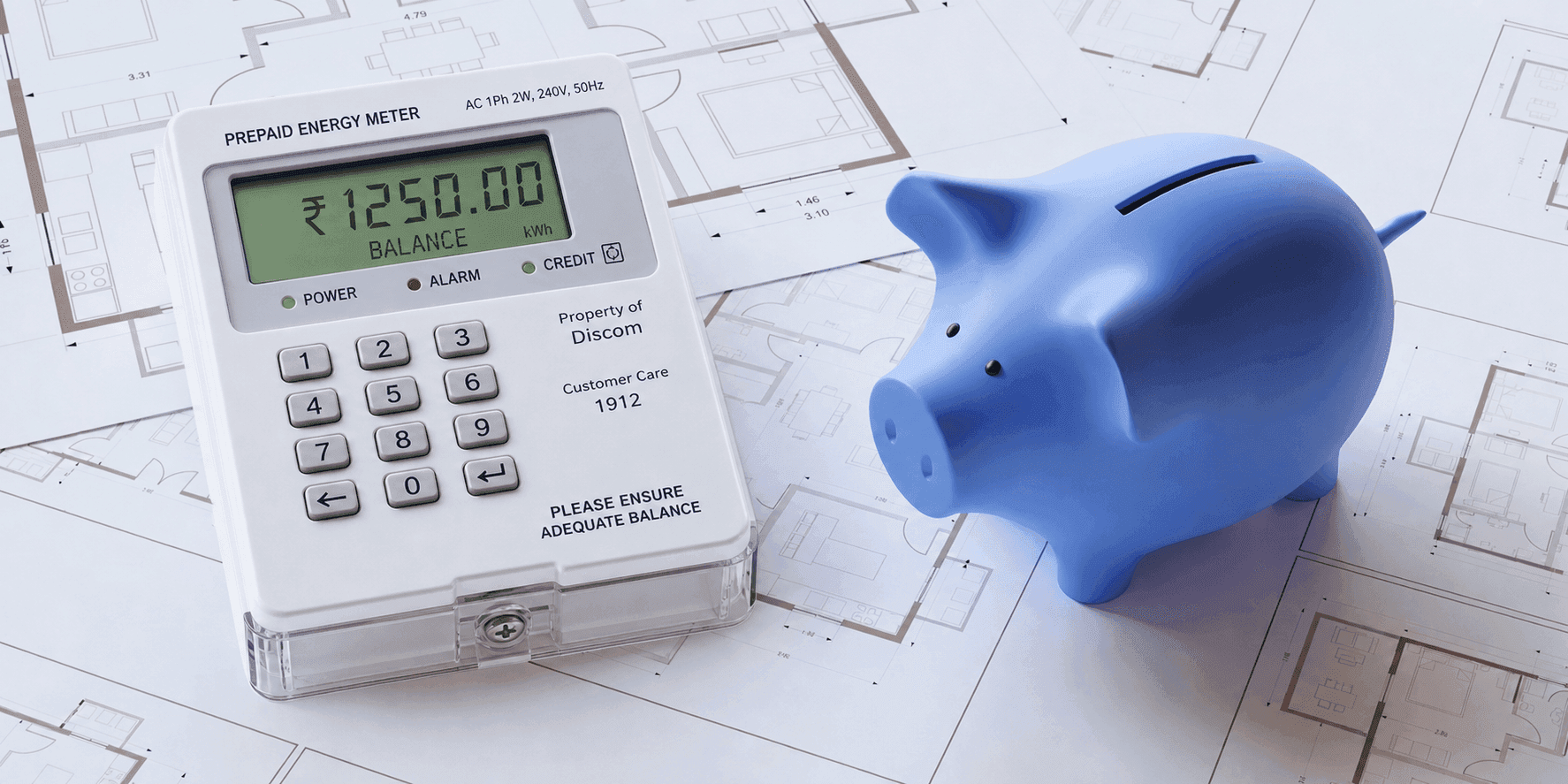
A device that lets you pay for the electricity, gas or water upfront before you use it. It tracks your balance in real-time and automatically shuts off the supply when your money runs out, operating just like a pay-as-you-go mobile phone.
If you have ever used a prepaid SIM card, you already know how a prepaid meter works. Instead of getting a bill after the usage of utilities, you can buy credit beforehand. As you turn on your lights, run the AC, etc., your balance ticks down in real time.
Why should you have a Prepaid meter?
When explaining the purpose of prepaid meters, the core message is control. It changes utility management from a passive, unpredictable monthly expense into an active, manageable resource.
Below are the key benefits of using a prepaid meter:
- Complete control over your budget
The profit aspect of a prepaid meter is the elimination of "bill shock." There won't be any surprises because you have already paid in advance, and you will never receive an unexpected high electricity bill at the end. You can even choose to purchase a smaller amount of credit to get by, rather than being forced to pay a massive lump sum on a fixed due date.
- Real-Time tracking drives more savings.
Prepaid meters feature a digital screen (and usually link to a smartphone app) that shows your balance ticking down in real time. When people can actively see that turning on the microwave or air conditioning causes their balance to drop faster, they naturally adjust their habits. Studies consistently show that changing to a prepaid system reduces a household's energy consumption by 10% to 15%.
- Freedom from utility arrears
With conventional post-paid billing, if you fall behind on a payment, the debt rolls over, accumulates interest and can quickly spiral out of control. With a prepaid meter, you can only consume the energy you have already paid for. It is mathematically impossible to run up a massive debt with the utility company.
- No security debts or hidden fees
When moving into a new apartment or setting up a new utility account, providers demand a hefty safety deposit to safeguard themselves against unpaid future bills. With the help of prepaid meters, the provider is already paid in advance. They usually waive the requirement for a security deposit entirely, making it much cheaper and easier to get your utilities connected.
A common worry for beginners is "What if my power cuts out in the middle of the night because I forgot to top up?"
Modern smart meters solve this with friendly hours (they won't disconnect during nights, weekends or public holidays) and emergency credit (a small buffer balance you can activate to keep the lights on until morning).
Features of prepaid meters
To understand a prepaid meter, you can compare the meter with a computer rather than a measuring box. It depends on a few core components and smart features to track your energy consumption and process the payments accordingly.
The core hardware components.
- The digital LCD: It features a clear screen that takes you through critical information such as your remaining balance, your energy consumption and your unique meter number.
- The keypad: If you are using a token-based system, the meter will have a physical numeric keypad. This is where you manually enter your 20-digit encrypted code, which you receive when you buy credit.
- LED warning lights/audio alarm: Most meters have an audio buzzer or flashing LED lights to notify you to top up when your balance drops below the expected threshold.
The smart software and connectivity features.
- The internal disconnection relay (the switch): This is the heavy-duty internal switch that handles the power supply. The moment the meter calculates that your balance has hit zero, it signals the switch to immediately disconnect the power supply.
- Built-in communication modules: Modern prepaid meters don't require you to type in codes. They have built-in cellular radio communication. They allow the meter to directly notify the utility company's central server to update your balance the moment you top up.
- Tamper Detection Sensors: To prevent energy theft, these meters are equipped with highly sensitive anti-tamper mechanisms. The meter instantly shuts off the power supply and sends a silent alert to the utility company when there is an energy theft.
Essential consumer protection
- Emergency credit: If you run out of your balance at an inconvenient time, you can press a specific button to activate the "emergency credit". This gives you a small buffer time to handle your urgent work.
- Friendly hours: Most utility providers program the meters with strict rules regarding when they are allowed to cut off. The meter will never generally get disconnected during the night. Any power used during emergency hours will be carried over as a temporary negative balance until the next business day.
A step-by-step guide to make your prepaid meter work
The lifecycle of a prepaid meter is a continuous loop. It starts from your wallet, goes through the utility network and into your home's main power panel.
Step 1 - Purchasing credits
Buy electricity units or credits in advance through various authorized methods, mainly through digital platforms (mobile banking apps, digital wallets or utility portals) and physical points (local vending stations, supermarket pay points and utility office counters)
Step 2 - Generating the token or syncing data
Once the payment is completed, the system links the purchase to your unique meter ID. There are mainly 2 methods to generate your token. The token system, where you receive a 20-digit numerical token printed on a receipt or sent through SMS and the smart online meters, where the recharged data uploads directly to a cloud server and updates your meter automatically via wireless networks.
Step 3 - Loading credit onto the meter
If your utility uses a token or card system, you must input the credit manually using the keypad entry, where you punch the 20-digit code into the meter and press "enter", or another method is through smart cards, where you insert or swipe against the meter.
Step 4 - Real-time tracking and consumption deduction
Based on the usage of electricity flowing into your homes, the meter converts this usage into kilowatt-hours (kWh) and instantly deducts from your available balance based on the utility's tariff rate.
Step 5 - Low-balance alerts
When the balance comes below a specific limit, the meter sends out a warning through flashing red LED lights or an audible beeping sound as a reminder for you to recharge your balance.
Step 6 - Automatic Disconnection
Once your balance reaches zero, an internal switch automatically cuts off the electricity supply to your property. This stops you from accumulating utility debt.
Step 7 - Recharging and reconnection
To bring back the power on, follow the steps mentioned below.
Steps to recharge a prepaid meter
The general steps to recharge a prepaid meter depend on whether you have a modern smart meter or an older keypad system.
Option 1 - Modern smart meters (Automated)
Modern smart meters sync online, which means you do not need to type in the code.
- Open your utility provider's app or a payment platform (like Paytm, Google Pay or Phone Pe).
- Look for the "Bill Payments" or "Recharge" section on the home screen. Tap on the electricity icon.
- Scroll through the list or type in the search bar to select your specific state electricity board or utility provider.
- Select your electricity board and enter your unique consumer ID or meter number. You can find this number printed on your physical electricity bill copy or on your meter's screen.
- Choose your recharge amount and complete the payment via UPI, net banking or debit card.
- Wait for a few minutes for the system to wirelessly send the credit directly to your meter. It may take nearly 5 to 15 minutes to update the new balance.
Option 2 - Keypad meters (Manual Token)
Older prepaid meters require you to type in a 20-digit code manually.
- If the meter is blank or dark, press any numeric key once to wake up the digital LCD display. Ensure it is clear and ready.
- Use the keypad to enter the 20-digit token code (steps to obtain the 20-digit encrypted code is explained in the next section) sequentially from left to right.
- If you make a mistake, you can clear the numbers using the backspace or clear key. This is usually a blue/yellow arrow key or the asterisk button (*), depending on your meter brand.
- Once all the 20-digit are typed in correctly, look for the enter key. On Indian prepaid meters, it’s mostly the green button, the hash (#) button, or a button with a tick icon. Press it firmly once.
How do you receive the 20-digit token code?
In India, the 20-digit code required to recharge a manual keypad meter is technically known as an STS token (Standard Transfer Specification).
Because a standalone keypad meter is not connected to the internet, your electricity board cannot send the money directly to your meter. Instead, they encrypt the money you paid to a 20-digit number.
To obtain the code, there are three main methods:
The UPI method:
- Open your preferred UPI app and go to electricity bill/utilities.
- Select your state and your electricity board (e.g., BESCOM)
- Choose the Prepaid Meter (if it asks for prepaid or postpaid option)
- Enter your consumer ID or the meter serial number and complete the payment.
- Once the transaction is completed, do not close the application. Scroll down the page and look for the field labelled as "Token Number", "Recharge Code", or "Key Code".
- If you accidentally close the screen, open the app's transactions page, click on the electricity payment and view the receipt to get your code.
The official website/app method:
- Surf through your electricity board's official consumer portal.
- Look for the link or section that says "Prepaid Recharge" or "Generate Voucher/Token".
- Enter your consumer ID, and the system will generate your registered name and address to confirm your identity.
- Complete the payment.
- Once paid, the website will generate a downloadable PDF payment receipt. The 20-digit number will be printed in bold text right at the top or bottom of the official slip.
The automated SMS/WhatsApp alerts method
- The moment a transaction is cleared via any online portal, the utility system sends an automated SMS to the mobile number linked to the consumer account. The text message reads: “Dear Consumer, your recharge for meter no XXXXX is successful. Your 20-digit recharge token is XXXX-XXXX-XXXX-XXXX-XXXX.”
Two important rules for Indian Tokens:
- If you buy multiple recharges in one day (e.g., a Rs. 500 recharge and then a Rs. 200 recharge because you needed more), you must punch in the 20-digit token for the first recharge into your meter before typing in the second one, because each time you recharge, a new token is always generated.
- The 20-digit token is encrypted specifically for your meter alone. You cannot enter your token in your neighbour's meter; it will instantly reflect as a failure.
How does a prepaid meter work? (Technical Aspect)
To understand the working of a prepaid meter, think of it like a tiny specialized computer attached to your wall. It has three basic tasks: counting electricity, subtracting the balance and controlling a switch.
- Counting the electricity (the sensor)
As you turn on the appliance (like a fan, AC), electrical current flows from the main street line, through your meter and into your house. The sensors inside the meter act like a continuous speedometer. They measure exactly how much voltage and current are flowing through at a given microsecond. The meter's internal microchip takes these measurements and converts them into standard power units (Kilowatt-hours or kWh).
- Subtracting the money (the calculator)
When you enter your 20-digit token code for a Rs. 1000 recharge, you are adding a specific balance into the meter's memory. The meter knows your current government electricity rate (tariff). As the sensors count the power units you have used, it immediately subtracts from your balance. If you look at the screen, you can see the balance coming down.
- Cutting the power (the switch)
The switch stays tightly closed, allowing electricity to flow freely into your home. The tiny computer chip sends an electrical pulse to this switch. The switch physically pops open, breaking the circuit and instantly stopping the flow of power to your house. The moment you enter a new valid token number, the computer chip immediately recognizes the money and fires a pulse to close the switch, and your lights snap back automatically.
How does it recognize the 20-digit code without the internet?
This is a question that creates curiosity for many. Older keypad meters do not have any internet connection, so how does it know if you have recharged? The answer is a mathematical formula (an encryption key) shared between the electricity board's computer and your meter. When you pay, the utility company's computer locks your amount paid and your specific meter number inside that 20-digit code. When you type those 20 digits into the keypad, the meter uses its own internal formula to "unlock" the code, confirming its genuineness and adding the amount to your meter.
How prepaid electricity metering works in a building
As mentioned before, prepaid metering changes when electricity is paid for. We have to pay upfront before we can use it, but it is a useful system and has to do more than just show a balance.
- Residents should be able to understand the charges
- It should provide dependable readings, and the building authority has a clear way to resolve disputes and account questions.
- The meter and the account system have to support both.
The meter and the account are different parts
The electricity meter records the quantities it is configured to measure. The wider prepaid system manages credit and the applicable account rules. Some functions may be supported in the meter; others depend on the software, communications and service.
Do not assume that every device with “prepaid” in its description uses the same recharge method. A keypad token, a mobile payment workflow and a centrally managed account are different arrangements.
Define the supply sources and charges
In a building with utility and generator supplies, consumption may need to be recorded and charged by source. The metering arrangement must identify the source correctly, and the account rules must explain the applicable charges.
Write down fixed charges, energy rates and any other approved account items. Make the information available to occupants before rollout. A clear statement is more useful than a dashboard balance that changes without explanation.
Confirm the account workflow
Establish how an account is created, how credit is added, how a receipt is obtained and where a customer can review consumption. Test the workflow using the actual platform and payment arrangement. Do not publish generic recharge instructions taken from another meter system.
For account problems, define who can correct a posting, how adjustments are recorded and how the occupant is informed. This prevents the facilities team and the payment provider from sending the same issue back and forth.
Agree low-credit and interruption behaviour
Specify the notifications and operating rules the deployment supports. Any credit-related disconnection or restoration arrangement must follow the approved project rules and applicable requirements. Do not treat this as universal behaviour for all prepaid meters.
Also define what happens if communication is lost or a payment is not immediately reflected. Users need a real support route and instructions that fit their system, not a promise that every problem will resolve automatically.
Choose the hardware for the installation
Confirm single-phase or three-phase measurement, direct or CT-operated input, source arrangement and the communication network. Check the exact model and accepted use for the project. Include the head-end software, gateways where required, account setup and ongoing service in the quotation.
A staged pilot can expose coverage or workflow problems before every unit is connected. Compare meter readings, account entries and the occupant-facing information during that pilot.
Give residents a concise operating guide
The final guide should show the actual recharge method, how to view a balance and consumption, where to see the tariff and how to contact support. Use screenshots from the deployed system and keep the instructions with the handover.
Discuss a prepaid or postpaid deployment
Share the number of units, supply sources, expected current, network conditions and account workflow. Elmeasure’s prepaid/postpaid and smart-meter pages can help identify the product configurations to review.
Key differences between smart meters and prepaid meters
People often mix up smart meters and prepaid meters because many modern devices do both jobs. However, they are fundamentally different concepts: a prepaid meter defines how you pay, while a smart meter defines how the meter communicates.
| Features | Prepaid Meter | Smart Meter |
|---|---|---|
| Payment and Billing | Strictly advance payment. You buy credits beforehand, and the power cuts off automatically when the balance hits zero. | Primarily postpaid (billed at the end of a cycle based on digital records), though some models can support prepaid functions. |
| Technology and Connectivity | Simple, basic devices focused almost entirely on credit monitoring and automated disconnection. They offer minimal data. | Highly advanced, IoT-enabled devices that measure usage in real-time and automatically transmit detailed data back to the utility company. |
| Features and Data Analysis | Provide minimal data (just your remaining credit). Tracking must be done manually by checking the box. | Provide deep insights (hourly, daily or weekly tracking). They support smart home integration, high-usage alerts and dynamic pricing (tariffs that change based on time-of-day demand). |
| User Experience | Simple to use and prevents “surprise bills” but carry the risk of abrupt, inconvenient power disconnection if you forget to top-up. | Seamless, convenient experience. Users track detailed graphs on phones or dashboards with zero risk of sudden shutoffs. |
ELMEASURE as the leading manufacturer of Prepaid Meters
Elmeasure establishes its position as a leading manufacturer by delivering a unified, multi-utility hardware that goes beyond the traditional electricity tracking. Their PE 51XXP series functions as an all-in-one device capable of measuring electricity, gas and water simultaneously within a single unit. This is achieved through the integration of four factory-configured digital inputs that seamlessly process pulse data from external water, gas or BTU meters, eliminating the need for separate tracking hardware.
The manufacturer also stands out through its advanced communication architecture and robust Advanced Metering Infrastructure (AMI). The meters utilize long-range, wireless LoRa communication equipped with an external antenna to transmit secure, real-time data directly to central servers. For properties requiring localized or hardwired installations, Elmeasure provides built-in RS485 communication ports running on the industry-standard Modbus RTU protocol. This advanced connectivity feeds into our proprietary Theiox (PPS) software program, which automates meter readings, runs easy utility billings and enable property managers to push single-click tariff updates across an entire network from a single centralised location, wiping out manual reading errors.
How our prepaid meters are embedded with IoT Technology.
Elmeasure’s prepaid meters are integrated with IoT (Internet of Things) technology primarily through their communication architecture, real-time data streaming and centralised cloud platform management.
- Long-Range wireless connectivity
At the core of our IoT integration is AMI utilizing wireless LoRa (Long-range) communication. The 51XXP series meters are equipped with an external antenna to establish long-range wireless connections.
- Real-Time data collection and edge sensing
Instead of storing consumption data to be read manually at the end of the month, Elmeasure’s meters act as active IoT sensors. They feature true RMS sensing with a rapid 1-second update time. This enables to collect and transmit 4-quadrant power and energy usage data in real time, turning the physical meter into an interactive data point on the network.
- The THEIOX cloud system
The IoT hardware infrastructure is fully paired with Elmeasure’s proprietary software platform, THEIOX (PPS). THEIOX allows for automated meter reading (AMR), remote grid management, load analysis and instantaneous, single-click tariff updates pushed across the entire machine network over-the-air. End users can leverage a dedicated mobile application to track live energy charts, monitor remaining balances, analyze usage patterns and perform instant online recharges that sync wirelessly back to the meter within minutes.
Conclusion
The evolution from traditional prepaid meters to advanced smart meters is no longer just a choice for individual households, it has become the backbone of India’s national strategy to modernise its power sector. Under aggressive central initiatives like the Revamped Distribution Sector Scheme (RDSS), the Government of India has targeted the replacement of 250 million conventional meters with the modern smart prepaid meters. This massive upgrade is a deliberate masterstroke designed to solve two major challenges at once:
- For the nation (the smart grid) – Real-time data transmission allows DISCOMs to drastically reduce commercial loss, track power theft, and predict grid demand across states accurately.
- For the common man (the prepaid control) – Integrating the prepaid model into these smart meters ensures that consumers retain absolute, transparent control over their daily budgets via smartphone apps, eliminating the era of manual reading errors and unexpected monthly bills.
By removing the lines between “smart” and “prepaid”, India is mot just upgrading hardware on a wall; it’s building a self-healing, highly efficient digital power grid.
Share this blog

Sign up to our newsletter.
Receive new product announcements, industry-relevant news and advance notice on upcoming deals.

Stay connected with us:



Products
Contact Us
- No. 47-P, KIADB Hardware Park,
Huvinayakanahalli Jala Hobli,
Yelahanka Taluk,
Bengaluru - 562149 - 1800-120-5048
- info@elmeasure.com
© 2026 Elmeasure

Loading...